2.0 refactor #161
2.0 refactor #161
Conversation


|
This looks good to me and I am +1 for merging it, however, I'm assuming that this is a WIP, since just the single group measures were refactored, right? |

|
sweet. yeah, still WIP, just wanted to get some feedback/buy-in for this approach. I'll keep going with the multigroup indices |

|
this is ready to go. The main benefit is we adopt the logic of Reardon & Osullivan, that we can derive generalized spatial indices by transforming the input data of aspatial indices through a weights matrix (so, e.g. now we can compute multiscalar profiles for any the original tests are unchanged to show that the (aspatial) calculations are still correct, with one exception: MinMaxS has a very different estimate. I think its correct, but want to flag this one did change aside from the reorganization, there's one important API change, which is that fitted indices have the attribute |

Codecov Report
@@             Coverage Diff             @@
##           master     #161       +/-   ##
===========================================
- Coverage   85.75%   65.77%   -19.98%
===========================================
  Files          65      116       +51
  Lines        2779     4322     +1543
===========================================
+ Hits         2383     2843      +460
- Misses        396     1479     +1083
Continue to review full report at Codecov.
|

|
(tests are all passing, there's a CI issue with rtree on windows) |

| statistics : np.array(n,k) | ||
| Local Diversity values for each group and unit | ||
|
|
||
| core_data : a pandas DataFrame |

There was a problem hiding this comment.
The PR looks good to me. But wasn't supposed to return data rather than core_data?
There was a problem hiding this comment.
its ok here because we set the class attribute appropriately (so even though we return the variable core_data above, its contents get set to the class attribute named data)
|
Awesome, @knaaptime! By the way, when you say "MinMaxS has a very different estimate", you mean the "MinMax" from https://github.com/knaaptime/segregation/blob/2.0/segregation/singlegroup/minmax.py, right? Any clue of why this might be happening? 'Cause it seems like nothing changed in the code/math behind it, right? |
|
right, the math and the function that actually compute the statistic havent changed. I thnk the root is this line in the new version, whereas the old code probably created a Kernel weights object from unprojected data |
Yep, this might it, perhaps the new version of |

|
puts gp at 0.9.0 and problem with |
|
thanks martin |

| c = 1-dist.copy() | ||
|
|
||
| Pxx = (data.xi.values * data.xi.values * c).sum() / (X ** 2) | ||
| Pyy = (data.xi.values * data.yi.values * c).sum() / (X*Y) |
There was a problem hiding this comment.
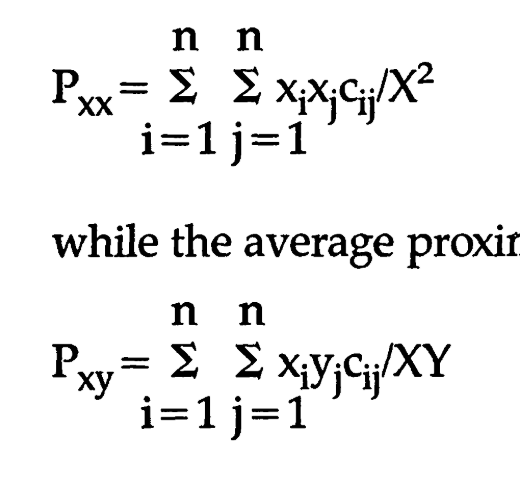
@renanxcortes one substantive change here: I edited this formula because i think the last version had a mistake (ycy/y^2 instead of ycx/yx)
There was a problem hiding this comment.
@knaaptime , the original version is the one that follows Massey and Denton. If we look closer at formulas (19) and (20) which are, respectively, Spatial Proximity and Relative Clustering, they both use the definition of Pxx and Pyy, which is our original implementation.
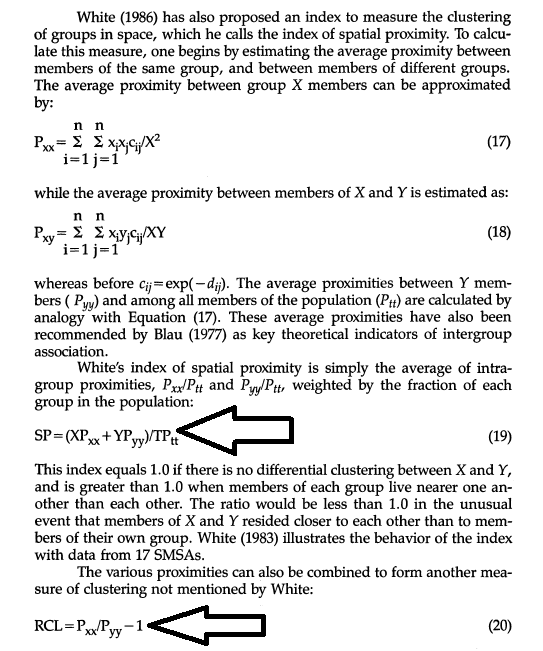
The definition of the "interaction" represented by "Pxy" is just for illustration.
There was a problem hiding this comment.
ah, snap. you're right

Add deprecation layer
add deprecation layer
6 participants


this starts the restructuring discussed in #4. i think it pretty substantially cuts down on repetition and makes the code much easier to navigate. We also get #104 for free