
End-to-end 8-bit, 5-stage pipelined CPU on Nexys A7 (Artix-7) — handwritten Verilog (RTL), MMIO-integrated embedded platform, verified bitstream.

Fig 1: Hardware-in-the-loop demonstration showing the five-stage pipeline executing the boot program and outputting 0x42 on the Nexys A7.
Keywords
End-to-end FPGA CPU · Five-stage pipeline · Embedded computing platform
This project implements and verifies an end-to-end 8-bit FPGA CPU system.
The CPU core is implemented in handwritten Verilog (RTL) using a classic IF / ID / EX / MEM / WB five-stage pipeline and is integrated with board peripherals via memory-mapped I/O (MMIO) to form a complete embedded computing platform.
The work covers the full engineering flow: RTL design → Vivado synthesis & implementation → bitstream generation → board programming & verification on a Nexys A7 (Artix-7) FPGA. Execution on real hardware demonstrates a reproducible execution path from instruction fetch through ALU and memory to external peripherals.

Fig 2: System-level datapath overview (exported from Vivado). Illustrates pipeline stage partitioning, principal module interconnections, and the MMIO peripheral interface.
Upon reset, the CPU executes a preloaded instruction stream and writes the computed result via MMIO to the display register. The Nexys A7 seven-segment display then shows 0x42 (decimal 66).
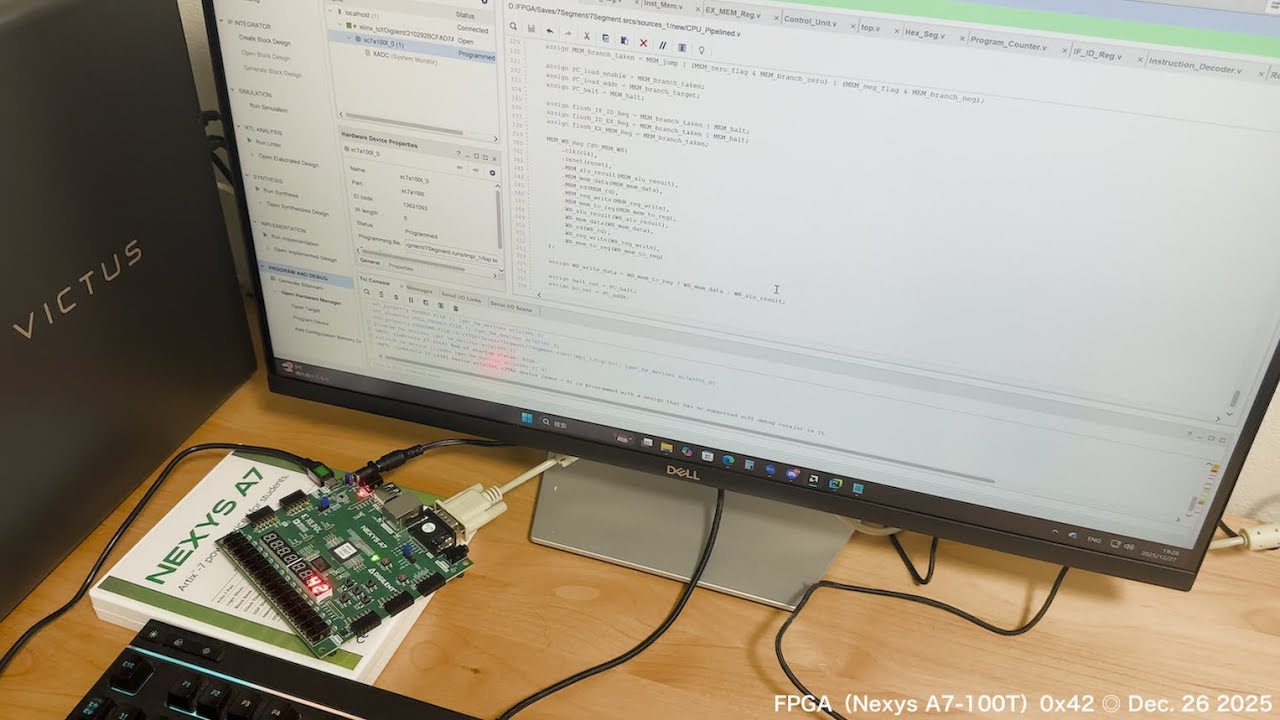
Fig 3: Live capture of board programming and execution, verifying the full instruction → ALU → memory → MMIO execution path.
- End-to-end FPGA engineering loop — Handwritten Verilog (RTL) → synthesis & implementation → bitstream → board verification.
- Five-stage pipelined microarchitecture — IF / ID / EX / MEM / WB partitioning with pipeline registers, control logic and flush support.
- Embedded platform integration (MMIO) — Memory-mapped I/O decouples core and peripherals (7-seg / LEDs / switches).
- Reproducible artifacts — Repository and Release include validated sources, constraints, reports and a bitstream.
| Feature | Specification |
|---|---|
| Data width / Instruction width | 8-bit data / 16-bit instruction |
| Pipeline | 5-stage (IF / ID / EX / MEM / WB) |
| Target device | Xilinx XC7A100T (Digilent Nexys A7-100T) |
| Toolchain | Xilinx Vivado (v2025.2 recommended) |
| Timing | Clock: 100 MHz; WNS = 4.844 ns (post-implementation) |
| Verification | Post-implementation timing closed; bitstream validated on hardware |
-
2025-11-24 — Logic modeling: Hand-constructed 8-bit CPU at gate/logic level to understand ISA decoding and instruction flow.
GitHub:https://github.com/CPU-YHC/Asymmetric-CallStack-8bit-CPU
-
2025-12-12 — Heterogeneous exploration: Extended to 16-bit architecture and implemented a simple mini-GPU (bouncing ball demo).
GitHub:https://github.com/CPU-YHC/turing-16bit-cpu/releases/tag/V2.1
-
2025-12-26 — RTL pipeline reconstruction (current): Reimplemented in handwritten Verilog RTL with a five-stage pipeline and completed end-to-end FPGA verification (displaying
0x42).
Provided for reproducibility and review:
hdl/— handwritten Verilog (RTL) sourcesconstraints/Nexys-A7-100T.xdc— board pin & clock constraintsbitstream/top_v1.bit— verified bitstream (Release asset)reports/— post-implementation timing & utilization reportsdocs/— architecture schematics and demo materials
- Completed: RTL implementation, five-stage pipeline, MMIO interface, Vivado implementation, and hardware demo.
- Current limitation: Hardware forwarding and stall units not yet implemented. Current demo uses software-inserted NOPs to manage data hazards. Future work will prioritize forwarding/stall logic and expanded test coverage.
V1.0 — initial public release containing RTL sources, implementation constraints and reports, a verified bitstream, and board-level demonstration materials.
MIT License
Project note: This project was independently developed by a 12-year-old student. With no formal mentorship, he relied solely on online videos and AI-assisted learning to complete the entire design and implementation. Experts are kindly invited to review the project and provide feedback or suggestions on how to best support his future development.